목차
GLM-5.3 and Claude Fable 5 are both designed for demanding coding and agentic workloads, but they optimize for different priorities. GLM-5.3 is now available on SiliconFlow, where developers can test it in the Playground and connect it to existing coding workflows through an OpenAI-compatible API.
Claude Fable 5 currently holds the advantage on several public and vendor-reported coding benchmarks. It also supports image input and a broader set of agent-oriented features. GLM-5.3, however, delivers competitive coding performance at substantially lower API prices, making it attractive for high-volume code generation, repository analysis, automated testing, and cost-sensitive agents.
The practical decision is which model completes your workload reliably at the lowest total cost.
Specifications, prices, model availability, and benchmark results in this article were checked on August 22, 2026. Model providers and inference platforms may update them over time.
GLM-5.3 vs. Claude Fable 5: Quick Answer
Comparison Area | GLM-5.3 | Claude Fable 5 |
|---|---|---|
Best fit | High-volume coding and cost-sensitive agents | Complex, long-running, multimodal agent tasks |
Context window | 1 million tokens | 1 million tokens |
Maximum output | 128,000 tokens | 128,000 tokens |
Input types | Text | Text and images |
Reasoning controls | Low, high, and max | Low, medium, high, xhigh, and max |
API input price | $1.40 per 1M tokens | $10 per 1M tokens |
API output price | $4.40 per 1M tokens | $50 per 1M tokens |
Public benchmark trend | Competitive, especially for its cost | Generally stronger absolute performance |
Main advantage | Price-performance ratio | Capability ceiling and agent tooling |
Main limitation | No native image input | Much higher token cost |
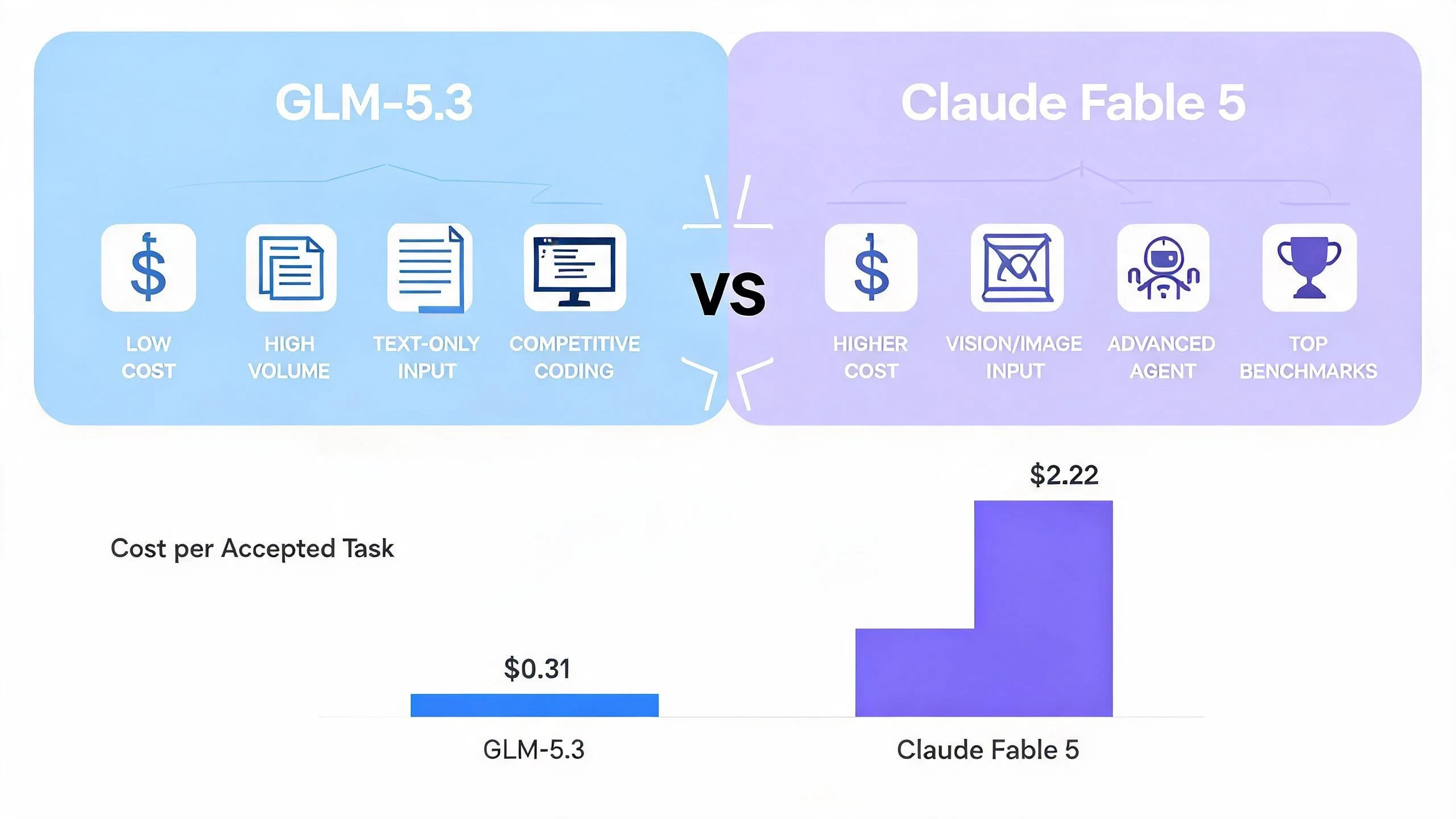
Choose GLM-5.3 when throughput and cost efficiency matter most. Choose Claude Fable 5 when a higher success rate on especially difficult tasks can justify a higher price. For production systems, routing requests by task complexity can be more economical than standardizing on either model alone.
Try GLM-5.3 on SiliconFlow Before You Choose
Start by running GLM-5.3 in the SiliconFlow Playground with the same coding prompts, repository excerpts, and acceptance criteria you plan to use in production. This provides a more useful signal than selecting a model from benchmark scores alone.
When you are ready to automate the evaluation, SiliconFlow's OpenAI-compatible API can connect GLM-5.3 to an existing coding agent or testing harness. Track task pass rate, retries, token use, latency, and human correction time before expanding traffic.
What Are GLM-5.3 and Claude Fable 5 Designed to Do?
GLM-5.3 is Z.AI’s coding- and agent-focused model. According to the GLM-5.3 documentation, it uses the same base model as GLM-5.2, with much of the improvement coming from post-training rather than a larger underlying architecture.
Its main capabilities include:
A 1-million-token context window
Up to 128,000 output tokens
Always-on reasoning
Function calling and structured output
Context caching
Streaming tool-call arguments
OpenAI Chat Completions, Responses, and Anthropic Messages-compatible interfaces
These features make GLM-5.3 suitable for code generation, repository-level analysis, debugging, test creation, code review, command-line tasks, and multi-step developer agents.
Claude Fable 5 is Anthropic’s high-capability model for coding, reasoning, tool use, and long-running agents. The Claude model documentation specifies the same 1-million-token context window and 128,000-token maximum output length, but Fable also accepts image input.
Its agent capabilities include code execution, programmatic tool calling, memory, context compaction, and adaptive reasoning. These features are valuable when a model must inspect screenshots, interact with development tools, preserve state across many steps, or continue working through a large task with limited human intervention.
GLM-5.3 emphasizes competitive coding performance and token efficiency. Fable 5 provides a higher capability ceiling and a more extensive agent feature set.
How Do GLM-5.3 and Claude Fable 5 Compare on Coding Benchmarks?
No single benchmark can determine which coding model is better. Results depend on the agent harness, prompts, reasoning settings, tool permissions, time limits, and token budgets.
The following GLM 5.3 vs. Fable 5 benchmark results provide directional evidence, but they should not be treated as perfectly controlled head-to-head tests.
Benchmark | GLM-5.3 | Claude Fable 5 | What It Measures |
|---|---|---|---|
Z.AI Code Bench | 34.5% at max reasoning | 39.5% at max reasoning | Complex coding tasks in Z.AI’s evaluation environment |
Terminal-Bench 3.0 | 28.3% reported by Z.AI | About 34.1% on the public leaderboard | Multi-step work in terminal environments |
DeepSWE v1.1 | 66.9% reported by Z.AI | About 69.7% in published evaluation results | Software engineering issue resolution |
In Z.AI Code Bench, GLM-5.3 Max reached 34.5%, compared with 39.5% for Fable 5 Max. GLM-5.3 High scored 31.4%.
The token figures add important context. Z.AI reports that GLM-5.3 Max used approximately 75,000 output tokens per task, while GLM-5.3 High used about 50,000. The lower reasoning setting therefore gave up 3.1 percentage points while reducing output-token usage by roughly one-third.
That trade-off may matter more in production than the highest score alone.
On Terminal-Bench 3.0, Fable 5 also leads. However, published results may use different harnesses and configurations. A model running through Claude Code cannot be directly compared with another model using a different scaffold, tool policy, or timeout.
The same limitation applies to DeepSWE v1.1. Fable 5 has the higher reported result, but the gap is smaller than the API price difference.
The benchmark evidence supports two conclusions:
1. Fable 5 currently has stronger absolute coding performance.
2. GLM-5.3 may deliver better performance per dollar, particularly when high reasoning is sufficient.
Teams should avoid turning these results into a universal ranking. The better model is the one that succeeds on representative tasks from the actual production workload.
Which Model Is Better Suited to Long-Horizon Agent Tasks?
Fable 5 is generally better equipped for the most demanding long-horizon workflows. Its adaptive reasoning, memory, compaction, vision support, and programmatic tool use help when a task requires hundreds of actions or frequent interpretation of changing state.
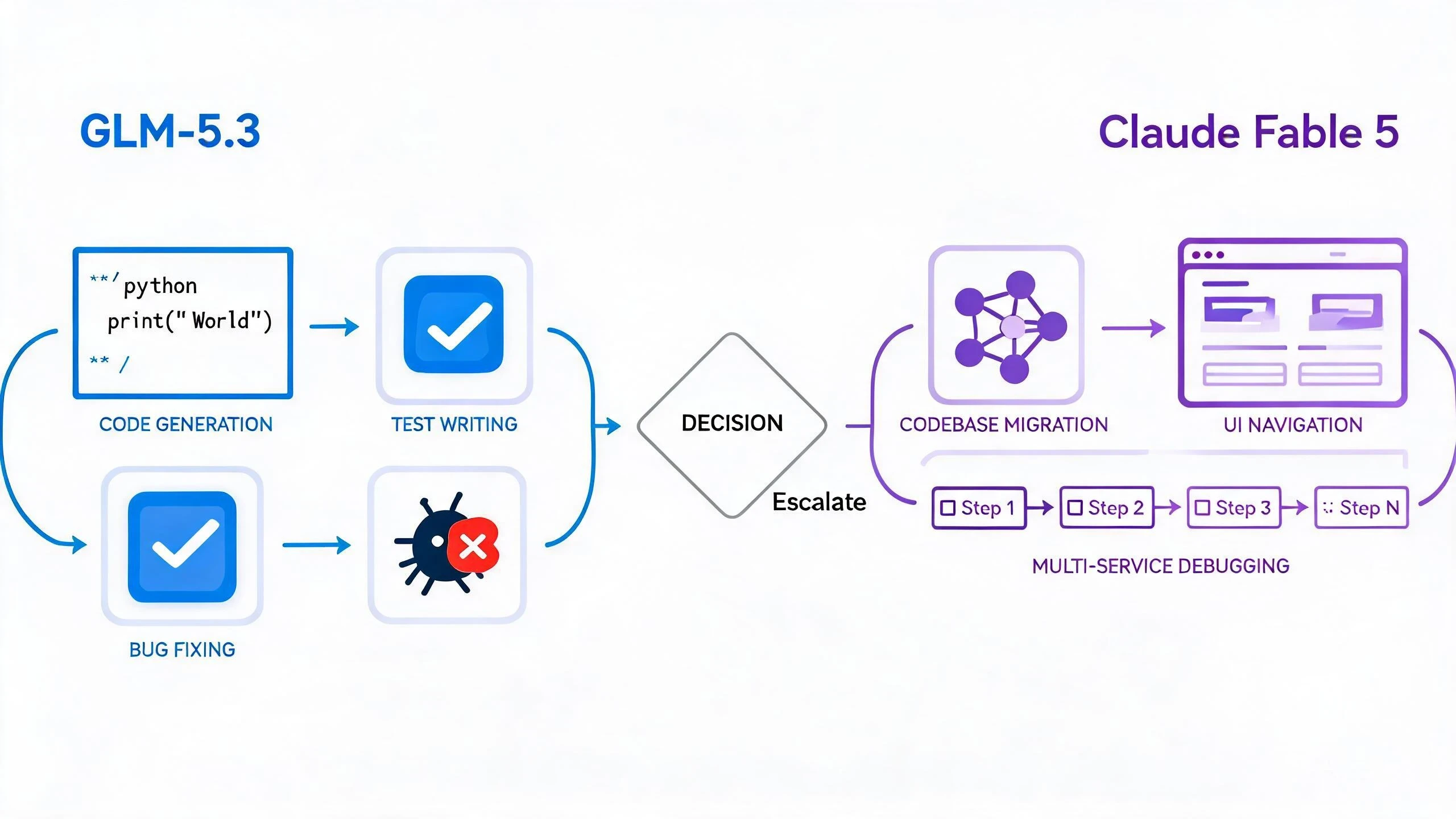
Examples include:
Migrating a large codebase
Debugging failures across multiple services
Navigating a visual interface
Investigating an incident using logs, code, and screenshots
Implementing a feature and repeatedly running tests
Refactoring a repository while preserving architectural constraints
Higher capability does not remove the need for agent controls. Anthropic documents that Fable 5 can return a classifier-based refusal with stop_reason: "refusal". Production systems should detect this response and route the task to a fallback model or a human reviewer.
Long-running models can also continue exploring after the useful work is complete. Independent testing by CodeRabbit found that Fable 5 could keep working until a harness timeout when completion criteria were unclear.
A reliable Fable agent should therefore include:
Explicit completion conditions
Maximum tool-call and token budgets
Wall-clock timeouts
Retry and fallback rules
Checkpoints before destructive actions
Test-based acceptance criteria
GLM-5.3 can also handle multi-step coding agents, especially when the workflow is structured and text-based. It becomes particularly compelling when the agent will run thousands of tasks and a moderate difference in per-task cost becomes a major infrastructure expense.
A useful operating pattern is to send routine tasks to GLM-5.3 and escalate only ambiguous or failed cases to Fable 5.
How Do Context, Reasoning Controls, Tool Use, and Vision Differ?
Both models provide a 1-million-token context window and up to 128,000 output tokens. Those limits are large enough for substantial repositories, long tool histories, and multi-file changes.
A large advertised context window does not guarantee that every token will be used equally well. Long-context quality depends on how information is ordered, whether irrelevant tool output is removed, and how the agent preserves important instructions.
Reasoning Controls
GLM-5.3 uses always-on reasoning with three effort settings:
Low
High
Max
Its default is max. For routine code generation, test writing, and simple bug fixes, high may provide a better cost-latency balance. Max is better reserved for difficult debugging, architectural changes, and tasks that fail at lower settings.
Fable 5 also uses adaptive thinking and offers five effort settings:
Low
Medium
High
Xhigh
Max
Its default is high. The additional levels allow finer control, although each level should still be evaluated against task success, latency, and token usage.
Tool Use
Both models can call external tools. The practical difference depends on how consistently the model selects tools, constructs valid arguments, interprets results, and recovers from errors.
GLM-5.3 supports function calling, structured responses, and streamed tool-call arguments. Fable 5 adds Anthropic’s agent-oriented features such as code execution, memory, compaction, and programmatic tool calling.
Vision
Fable 5 accepts image input; GLM-5.3 is text-only.
Vision matters when an agent needs to:
Read screenshots or design mockups
Diagnose visual regressions
Interpret charts or diagrams
Inspect rendered web pages
Work with image-based bug reports
If the workflow is limited to source code, logs, documentation, and structured tool output, the lack of native vision may not be significant.
How Do API Access and Pricing Affect the Decision?
API price is one of the clearest differences in the GLM 5.3 vs. Fable 5 comparison.
GLM-5.3 vs. Fable 5 Pricing
Token Category | GLM-5.3 | Claude Fable 5 |
|---|---|---|
Uncached input | $1.40 per 1M tokens | $10 per 1M tokens |
Cached input/read | $0.26 per 1M tokens | $1 per 1M tokens |
Output | $4.40 per 1M tokens | $50 per 1M tokens |
Five-minute cache write | No separate write price listed | $12.50 per 1M tokens |
One-hour cache write | No separate write price listed | $20 per 1M tokens |
Sources: Z.AI API pricing and Anthropic API pricing.
At the published rates, Fable 5 costs approximately:
7.1 times more for uncached input
3.8 times more for cache reads
11.4 times more for output
Consider a request billed for 100,000 uncached input tokens and 20,000 output tokens:
GLM-5.3: approximately $0.228
Fable 5: approximately $2.00
This example assumes the same billed token counts. Identical source text may tokenize differently across providers, so teams should compare actual API usage rather than estimating cost from word counts alone.
Token pricing is also not the same as total cost. A cheaper request can become more expensive if it requires repeated retries, produces unusable code, or needs extensive human correction.
A better metric is:
Cost per accepted task = total API and tool cost ÷ number of tasks that pass acceptance tests
For example, if GLM-5.3 costs $0.23 per attempt and succeeds 75% of the time, its approximate model cost per accepted task is $0.31. If Fable 5 costs $2.00 and succeeds 90% of the time, its cost per accepted task is $2.22.
Fable can still be the economical choice when one successful completion prevents hours of engineering work. For high-volume routine tasks, GLM-5.3 has a substantial price advantage.
How to Run a Fair GLM-5.3 and Claude Fable 5 Comparison
A fair evaluation should reproduce the production environment instead of comparing isolated chat responses.
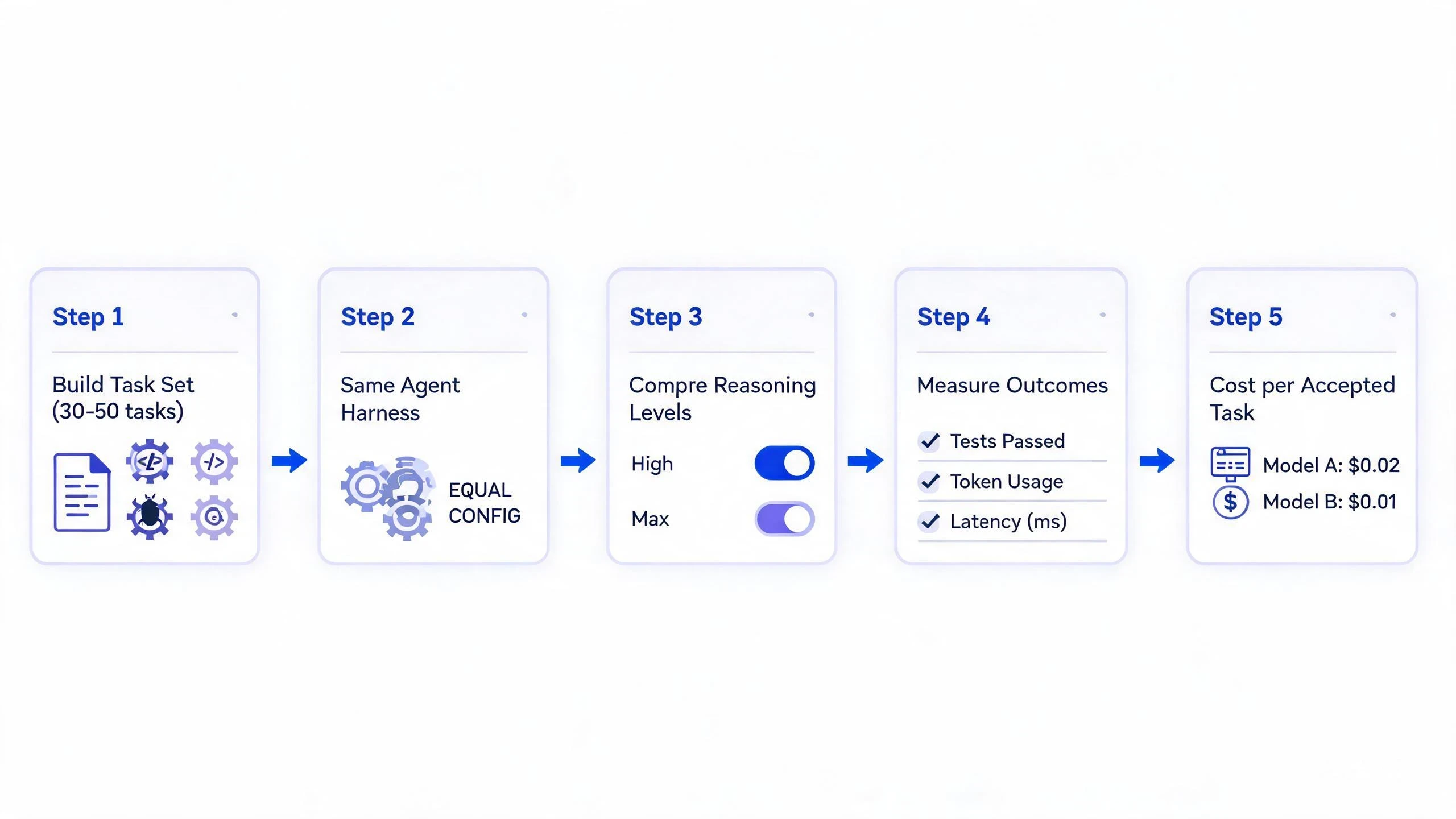
1. Build a Representative Task Set
Use at least 30 to 50 tasks drawn from real engineering work. Include a mix of:
Small bug fixes
Multi-file feature changes
Test generation
Repository navigation
Dependency upgrades
Refactoring
Terminal-based troubleshooting
Code review and security analysis
Remove proprietary data before sending tasks to third-party APIs.
2. Use the Same Agent Harness
Give both models equivalent access to files, shell commands, search, test runners, and documentation. Keep system instructions, retry rules, timeouts, and completion criteria as consistent as the APIs allow.
3. Compare Multiple Reasoning Levels
Testing only the maximum setting can exaggerate cost. A useful starting matrix is:
GLM-5.3 High and Max
Fable 5 High and Max
For routine workloads, include lower settings to find the cheapest configuration that still meets the acceptance threshold.
4. Measure Outcomes, Not Style
Score each task using objective criteria:
Did the tests pass?
Was the requested behavior implemented?
Did the model introduce regressions?
How many tool calls and retries were required?
How long did the task take?
How many input and output tokens were billed?
Did a human need to correct the result?
Do not reward a model merely for producing a longer explanation or more polished-looking code.
5. Test Failure Handling
Include difficult and deliberately underspecified tasks. Record refusals, invalid tool calls, repeated actions, timeouts, and false completion claims.
The agent should have clear policies for escalation, retrying, and stopping.
6. Calculate Cost per Accepted Task
Use production token counts, cache activity, tool costs, retries, and human review time. A useful evaluation table is:
Metric | GLM-5.3 High | GLM-5.3 Max | Fable 5 High | Fable 5 Max |
|---|---|---|---|---|
Task pass rate | ||||
Median latency | ||||
Tokens per task | ||||
Tool calls per task | ||||
Retry rate | ||||
Cost per attempt | ||||
Cost per accepted task | ||||
Human review time |
This process often reveals that different task categories need different models.
Because GLM-5.3 is now available on SiliconFlow, teams can move this evaluation from benchmark analysis into a repeatable testing workflow. Start with prompt-level checks in the Playground, then connect the model to an existing harness through SiliconFlow's OpenAI-compatible API.
The same application layer can support evaluation and routing across other models in the SiliconFlow model library. This helps teams compare different capability and cost tiers without rebuilding the full integration for every supported model.
Choose Between GLM-5.3 and Claude Fable 5 by Workload and Total Cost
The GLM 5.3 vs. Fable 5 decision can be reduced to the following workload matrix:
Workload | Recommended Starting Point | Reason |
|---|---|---|
High-volume code generation | GLM-5.3 High | Strong price-performance ratio |
Test and documentation generation | GLM-5.3 High | Maximum reasoning is often unnecessary |
Routine bug fixing | GLM-5.3 High, with escalation | Keeps average cost low |
Difficult repository-wide refactoring | Test both Max settings | Success rate matters more than request price |
Long-running autonomous agents | Fable 5 High or Max | Stronger agent tooling and capability ceiling |
Screenshot or UI-based debugging | Fable 5 | Native image input |
Text-only repository analysis | GLM-5.3 | Large context at lower token prices |
Low-frequency, high-value engineering tasks | Fable 5 | A higher success rate may justify the cost |
Large production task queues | Model routing | Avoids paying premium prices for routine work |
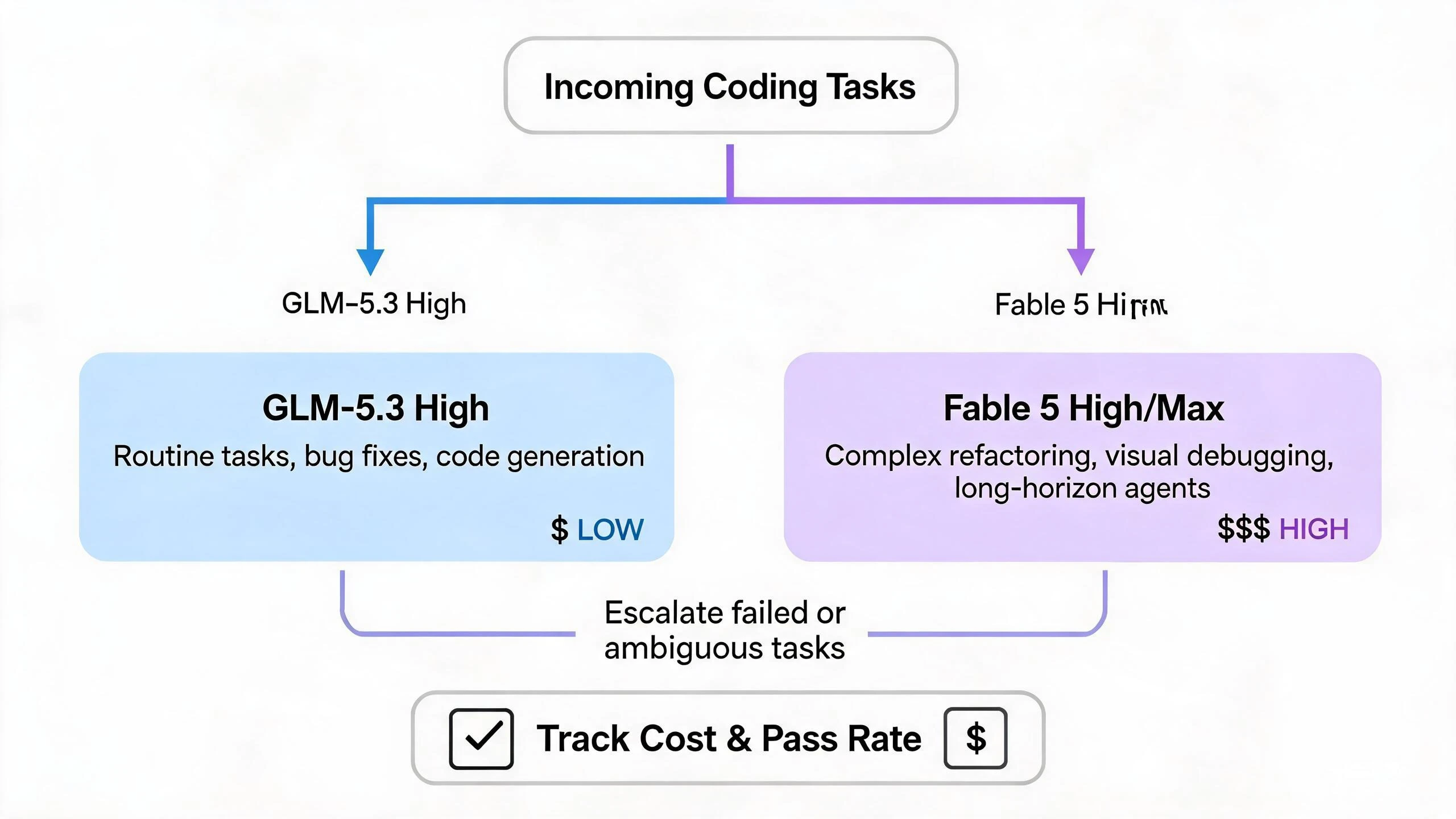
For most teams, the best architecture is a routing system:
Run predictable, high-volume tasks on GLM-5.3.
Validate the output with tests or automated checks.
Escalate failed, ambiguous, visual, or high-risk tasks to Fable 5.
Track cost and pass rate by workload category.
Update routing rules as model performance and prices change.
Claude Fable 5 is the stronger choice when the task demands maximum coding capability, native vision, or extensive agent tooling. GLM-5.3 is the stronger choice when competitive coding performance must be delivered across a large number of requests at a controlled cost.
The final decision should come from production-style evaluation rather than leaderboard position alone. Measure accepted outcomes, retries, latency, and human review together. That comparison determines which model creates more value in a real coding system.
FAQs
Q1. Can GLM-5.3 and Claude Fable 5 Produce Identical Results From the Same Prompt?
No. Model sampling, reasoning paths, tool responses, and context ordering can change the result. Even low-temperature runs may vary. Use automated tests, schema validation, and repeated trials when consistency matters instead of relying on one successful response.
Q2. Should an Entire Repository Be Added to the Model Context?
No. Sending every file can increase cost and distract the model with irrelevant code. Retrieve the files, symbols, tests, and dependency information needed for the current task, then let the agent request additional context when required.
Q3. Can Developers Replace One Model With the Other Without Changing Their Application?
Not always. API compatibility can simplify authentication and request formatting, but reasoning parameters, tool schemas, stop conditions, tokenization, and error responses may differ. Add a provider adapter and regression tests before switching models in production.
Q4. Should AI-Generated Code Be Reviewed Before It Is Merged?
Yes. Treat generated code like an external contribution. Require tests, static analysis, dependency scanning, secret detection, and human review for sensitive changes. Strong benchmark performance does not guarantee that a specific patch is secure, maintainable, or correct.
Q5. How Should Teams Handle Future GLM-5.3 or Fable 5 Model Updates?
Use versioned configurations and canary evaluations. Run each update against a fixed regression set before expanding traffic, then compare pass rate, latency, token use, refusals, and tool errors. Roll back when an update weakens production-critical behavior.