Kimi K3 Now Live on SiliconFlow: The First Open 3T-Class Model at Frontier-Level Performance
목차
TL;DR
Kimi K3 is now live on SiliconFlow: Moonshot AI's most capable model to date, 2.8T total parameters, native vision with 1M-token context.
Why it matters: It's the world's first open 3T-class model — posting frontier-level results across coding, agentic, and multimodal benchmarks, and ranking #1 on Arena's Frontend Code Arena at launch, ahead of leading closed models on a real product task.
What it costs: $3.0 / M input tokens and $15.0 / M output tokens, with cache reads at $0.3 / M.
Get started: SiliconFlow provides OpenAI- and Anthropic-compatible APIs for Kimi K3, so it drops straight into Claude Code, Cline, Hermes Agent, OpenCode, and your existing tools in minutes.
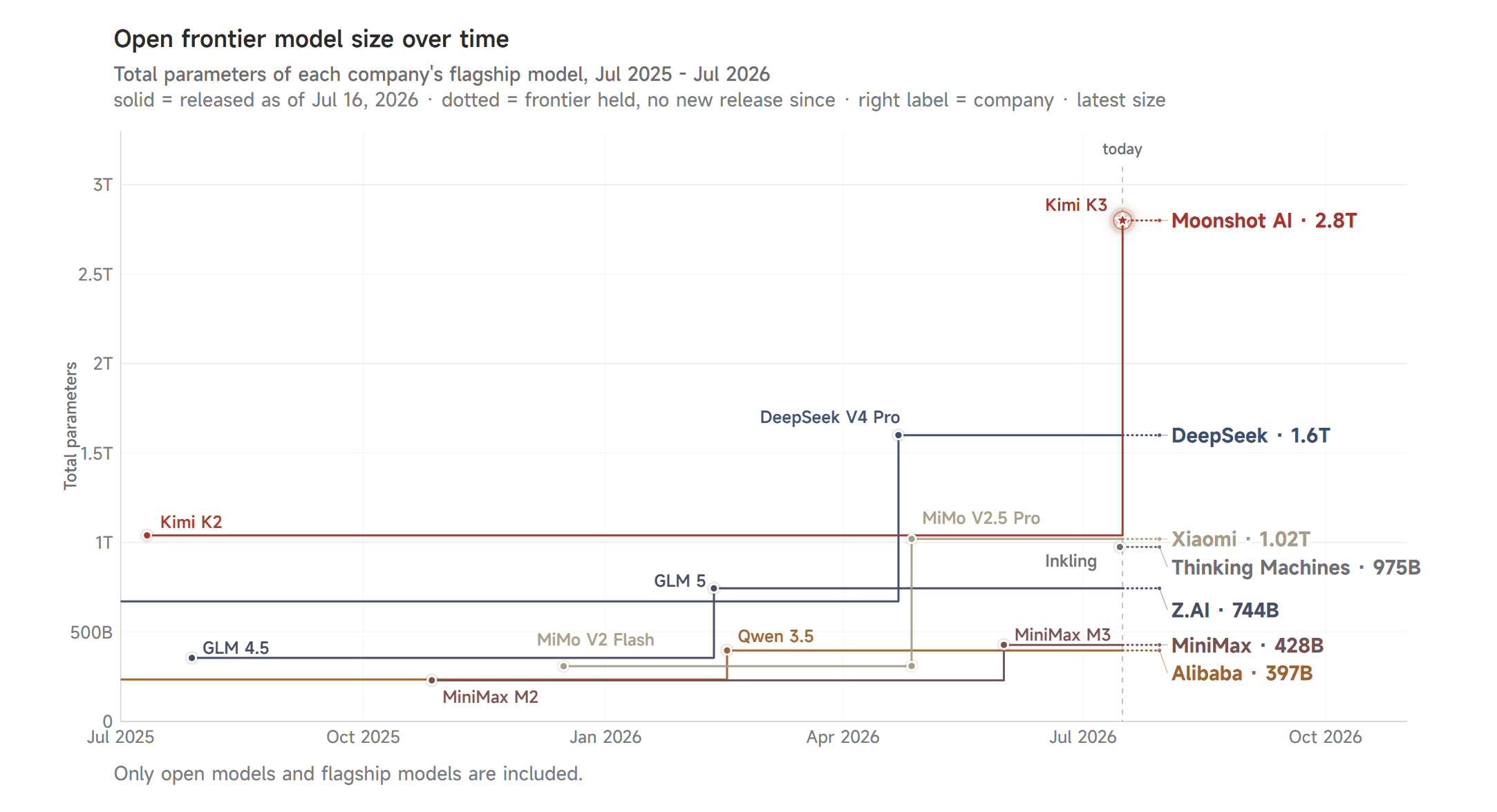
Until this month, the largest open-weight models topped out around a trillion parameters. Then Moonshot AI shipped Kimi K3: at 2.8 trillion parameters, it's the world's first open model in the 3-trillion-parameter class. But size isn't the story. On Artificial Analysis's independent Intelligence Index, K3 ranks third place overall — behind only Claude Fable 5 and GPT-5.6 Sol, and ahead of Claude Opus 4.8 — and it tops Arena's Frontend Code Arena. That's frontier-class capability at open-model pricing, and it's now live on SiliconFlow
Here's what you're working with:
Model String | moonshotai/Kimi-K3 |
Architecture | Mixture-of-Experts — Kimi Delta Attention (KDA) + Attention Residuals (AttnRes) |
Total Parameters | 2.8T (world's first open 3T-class model) |
Expert Activation | 16 of 896 experts, via Stable LatentMoE |
Context Length | 1049K |
Max Output | 1049K |
Precision | FP8 |
Modality | Text + image input (native vision), text output |
Reasoning | Max thinking effort by default (low/high modes to follow) |
Capabilities | Tool calls / JSON mode / image input |
Pricing on SiliconFlow | cache read $0.3 / M; $3.0 in / $15.0 out per M tokens |
Why Kimi K3 Stands Out
First Open 3T-Class Model
At 2.8 trillion parameters, Kimi K3 is the largest open model released to date—nearly 3× the size of its predecessor. It also extends Kimi's streak of setting the frontier for open-model scale in nine of the past twelve months.
Models this large usually come with a trade-off: they're expensive to train and slow to run. K3 narrows that gap. Kimi Delta Attention accelerates long-context decoding (up to 6.3× faster at one million tokens, according to Moonshot), Attention Residuals reduce training cost by around 25% for less than 2% extra compute, and its sparse Mixture-of-Experts architecture activates only 16 of 896 experts per token. Together, these improvements deliver 2.5× better scaling efficiency than Kimi K2—making a 3T-class model practical even at million-token context lengths.
Frontier Coding Capabilities
K3 excels at long-horizon work—from extended coding sessions and large repositories to agentic workflows and deep research. Those are also the areas where it posts its strongest benchmark results.
While it remains competitive with the best closed models across a broad range of tasks, Moonshot is upfront that K3 still trails Fable 5 and GPT-5.6 Sol overall. But bringing performance this close to close-sourced models is the bigger milestone. See Moonshot's full benchmark table for more details.
Benchmark | Kimi K3 | Claude Fable 5 | GPT 5.6 Sol | Claude Opus 4.8 | GLM-5.2 |
Coding | |||||
Terminal-Bench 2.1 | 88.3 | 84.6 | 88.8 | 84.6 | 82.7 |
Program Bench | 77.8 | 76.8 | 77.6 | 71.9 | 63.7 |
SWE Marathon | 42 | 35 | 39 | 40 | 13 |
FrontierSWE | 81.2 | 86.6 | 71.3 | 66.7 | 67.3 |
Agentic | |||||
BrowseComp | 91.2 | 88 | 90.4 | 84.3 | — |
DeepSearchQA | 95 | 94.2 | — | 93.1 | — |
Automation Bench | 30.8 | 29.1 | 29.7 | 27.2 | 12.9 |
MCP Atlas | 84.2 | 84.7 | 83.6 | 83.6 | 82.6 |
Reasoning | |||||
GPQA-Diamond | 93.5 | 92.6 | 94.1 | 91 | 91.2 |
Vision | |||||
MMMU-Pro | 81.6 | 81.2 | 83 | 78.9 | — |
OmniDocBench | 91.1 | 89.8 | 85.8 | 87.9 | — |
bold number = best score in each row
Native Vision, In the Loop
K3 can natively see what it's doing. Instead of relying on text descriptions, it can inspect a screenshot, update the interface, relaunch the app, and verify the result — keeping vision in the agentice feedback loop throughout the task. That makes iterative workflows like frontend development, game creation, and CAD significantly more reliable.
The same native vision capabilities also power document, chart, and diagram understanding. Because K3 reasons over visual content directly — not through a separate OCR pipeline — it handles image-rich documents as naturally as plain text.
See Kimi K3 in Action
Benchmarks only tell part of the story. To see how K3 performs on real-world work, we gave it a single prompt with four connected objectives: research Cities: Skylines, design a reusable specification for a frontend-only 3D city builder, build the game from scratch, and keep everything in a low-poly sci-fi style.
Instead of jumping straight into code, K3 researched the task, generated its own implementation blueprint, and then built the game end to end. When it encountered bugs during development, it diagnosed the issues, fixed them, and continued—all without additional prompting.
The result was a playable 3D city builder with procedural generation, a working simulation, and a cohesive visual style—all from a single session. More than the final game, what stood out was the workflow: K3 planned, built, tested, and iterated while staying on track throughout a long-running task.
Moonshot's launch showcase pushes it further still, from autonomous chip design to reproducing published scientific research; see the Kimi K3 offical demos for more.
Run Kimi K3 with Your Familiar Tools
Benchmarks and backstory can only tell you so much — the fastest way to know if K3 fits your workflow is to run it yourself. That only takes minutes.
Try it first, no setup
Open the SiliconFlow Playground and chat with Kimi K3 right in your browser. Tune temperature and top-p, or run it side by side against Kimi K2.7 Code or GLM-5.2 on the same coding prompt to see how it performs.
Plug into your tools
SiliconFlow APIs are both OpenAI- and Anthropic-compatible, so K3 drops straight into any tool that supports a custom provider — same SDK, same code, just a new base URL and model string. Live in minutes.
Tool | SiliconFlow Integration Guide |
Claude Code | |
Cline | |
OpenCode | Open-source AI coding agent for flexible development workflows |
Hermes Agent | |
And more |
What you need to connect:
Base URL | https://api.siliconflow.com or https://api.siliconflow.com/v1 |
SiliconFlow API Key | |
Model string | moonshotai/Kimi-K3 |
💡One tip for agent workflows: K3 is trained to preserve its thinking history within a session. For the most stable results, keep the full session with K3 and avoid switching a running conversation from another model over to K3 mid-stream. Using a harness with verified K3 compatibility gives you the smoothest experience.
Get Started Immediately
Try it: Start using Kimi K3 on SiliconFlow — run queries immediately, pay only for usage.
Integrate: Use our OpenAI-compatible API. Explore the full API specifications in the SiliconFlow API documentation. Moonshot recommends running K3 at
temperature = 1.0andtop_p = 1.0.