目次
DeepSeek V4 Pro is the more cost-efficient starting point on SiliconFlow, especially for coding workloads with large amounts of reusable context. GLM 5.3 deserves priority testing when long-horizon software engineering and multi-step agent execution matter more than the lowest token price.
The benchmark evidence does not support one model as the universal winner. GLM 5.3 leads several software-engineering and automation evaluations, while DeepSeek V4 Pro performs better on some repository and tool-use tests. The final decision should depend on completed-task cost, latency, retries, and human correction time in your own workflow.
DeepSeek V4 Pro vs. GLM 5.3 at a Glance
The following SiliconFlow deployment details and prices were verified on September 9, 2026.
On SiliconFlow, DeepSeek-V4-Pro-0813 has lower rates across uncached input, cached input, and output tokens. This difference becomes more important when a coding agent repeatedly sends the same repository context, system instructions, or tool definitions.
GLM-5.3 costs slightly more per token. Its evaluation results make it a relevant candidate for agents that must work across multiple files, operate development tools, inspect results, and revise their approach over an extended sequence. Both models are available through SiliconFlow’s Serverless API. This allows teams to compare them without maintaining separate inference infrastructure or rebuilding an entire application around another API format.
Area | DeepSeek V4 Pro | GLM 5.3 |
|---|---|---|
SiliconFlow model ID | deepseek-ai/DeepSeek-V4-Pro-0813 | zai-org/GLM-5.3 |
Best starting point | Cost-sensitive coding, repository work, and repeated long context | Long-horizon engineering and multi-step agent workflows |
Context window | 1,049K tokens | 1,049K tokens |
Input modality | Text | Text |
Tool calling | Supported | Supported |
Input price | $1.32 per million tokens | $1.40 per million tokens |
Cached-input price | $0.044 per million tokens | $0.26 per million tokens |
Output price | $3.96 per million tokens | $4.40 per million tokens |
Coding Performance: What the Benchmarks Actually Measure
Benchmark scores help narrow the testing order, but they do not prove which model will perform better inside a specific coding agent. Results can change with the agent harness, reasoning configuration, context-management strategy, tool permissions, timeout, and token budget.
The following figures come from Z.ai’s published GLM-5.3 evaluation. They compare GLM 5.3 with DeepSeek-V4-Pro-0813 on named benchmark versions. These are vendor-reported results rather than an independent test of the two SiliconFlow endpoints.
Benchmark | DeepSeek V4 Pro | GLM 5.3 | Main Capability Tested |
|---|---|---|---|
Terminal-Bench 2.1 | 87.9 | 88.2 | Multi-step work in terminal environments |
DeepSWE v1.1 | 62.7 | 66.9 | Long-horizon work in active software repositories |
NL2Repo | 61.1 | 58.0 | Repository-level implementation from natural-language requirements |
Toolathlon Verified | 74.1 | 73.0 | Tool selection and sequencing across realistic workflows |
AutomationBench v1.0.6 | 43.2 | 48.2 | Extended workflow-automation tasks |
Agents’ Last Exam CLI | 25.7 | 28.5 | Verifiable professional work completed through a CLI agent |
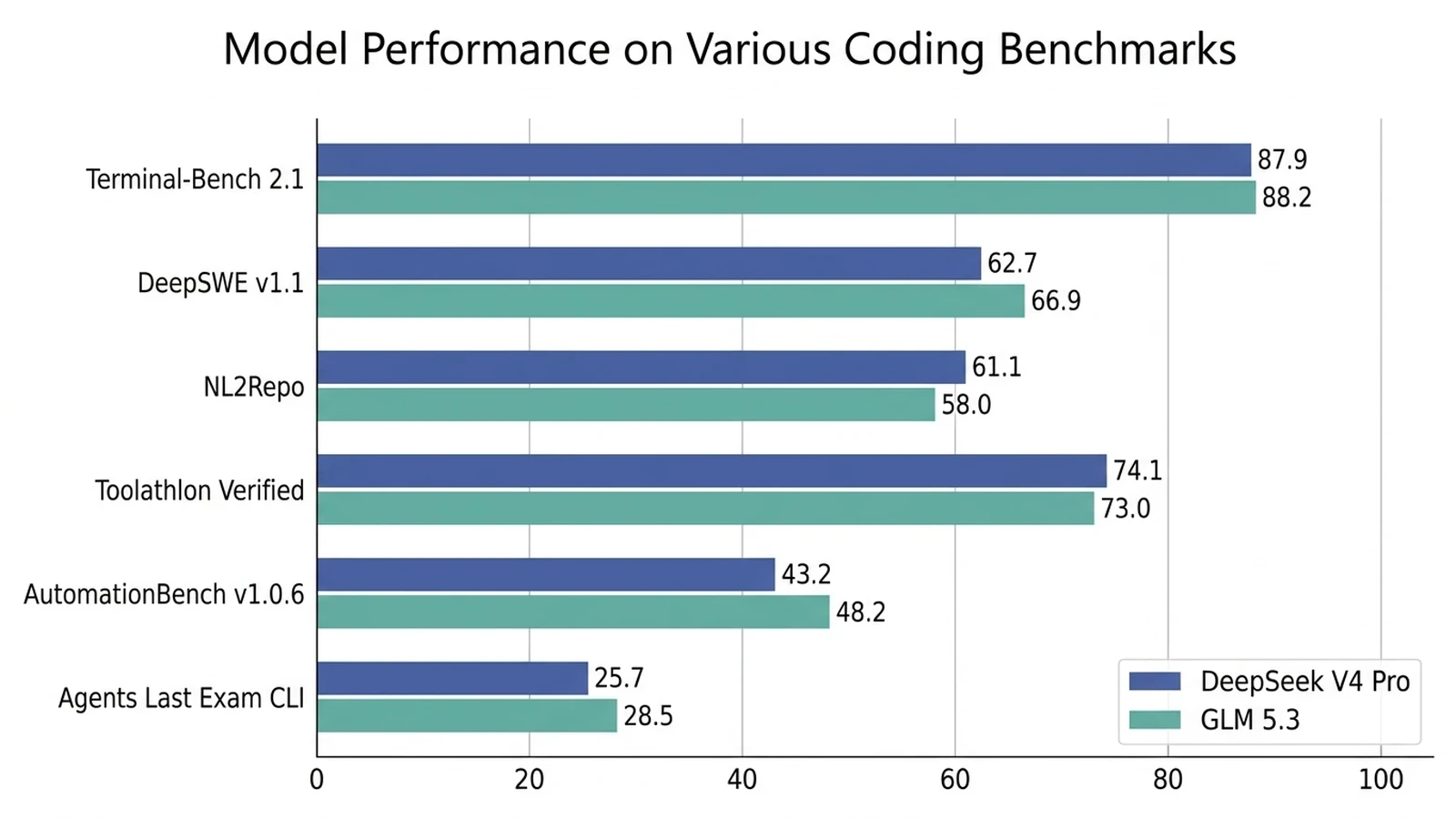
GLM 5.3 has the higher reported score on DeepSWE v1.1, AutomationBench, and Agents’ Last Exam CLI. DeepSeek V4 Pro leads on NL2Repo and Toolathlon Verified. The 0.3-point difference on Terminal-Bench 2.1 is too small to support a broad model-selection rule without repeated testing.
The benchmark names also represent different kinds of coding work.
DeepSWE v1.1 evaluates agents on original, long-horizon engineering tasks from active repositories. Solutions are graded from committed code in clean environments. This makes it more relevant to feature implementation and multi-file fixes than a benchmark based on isolated code snippets.
Terminal-Bench evaluates whether an agent can complete work inside terminal environments. A task may require file inspection, shell commands, dependency management, debugging, and artifact verification. The result therefore reflects both model capability and the surrounding agent harness.
Toolathlon Verified measures whether agents can select, sequence, and use tools across realistic software workflows. It provides a useful signal for tool orchestration, but it does not guarantee that a model will follow the schemas and business rules in your application.
Agents’ Last Exam covers longer professional workflows with verifiable outcomes. Its CLI subset is relevant to general agents that must gather information, modify files, use tools, and deliver a finished result.
Benchmark versions must remain separate. Terminal-Bench 3.0 contains harder and more varied tasks than Terminal-Bench 2.1. A score reported on version 3.0 should not be ranked directly against a score from version 2.1.
Tool Use and Multi-Step Agent Tasks
Both models support function calling through SiliconFlow. They can select a function, generate its arguments, receive the result, and continue working through additional steps using the OpenAI-compatible Chat Completions API. A tool-support label does not show how reliably a model will operate an agent. Production testing should check whether each model can:
Select the correct function when several tools have similar purposes.
Generate arguments that pass schema and business-rule validation.
Preserve file paths, task IDs, and other state across multiple calls.
Recognize unsuccessful commands instead of continuing from invalid results.
Interpret test output and modify its implementation.
Stop after meeting the acceptance criteria.
Request approval before an irreversible action.
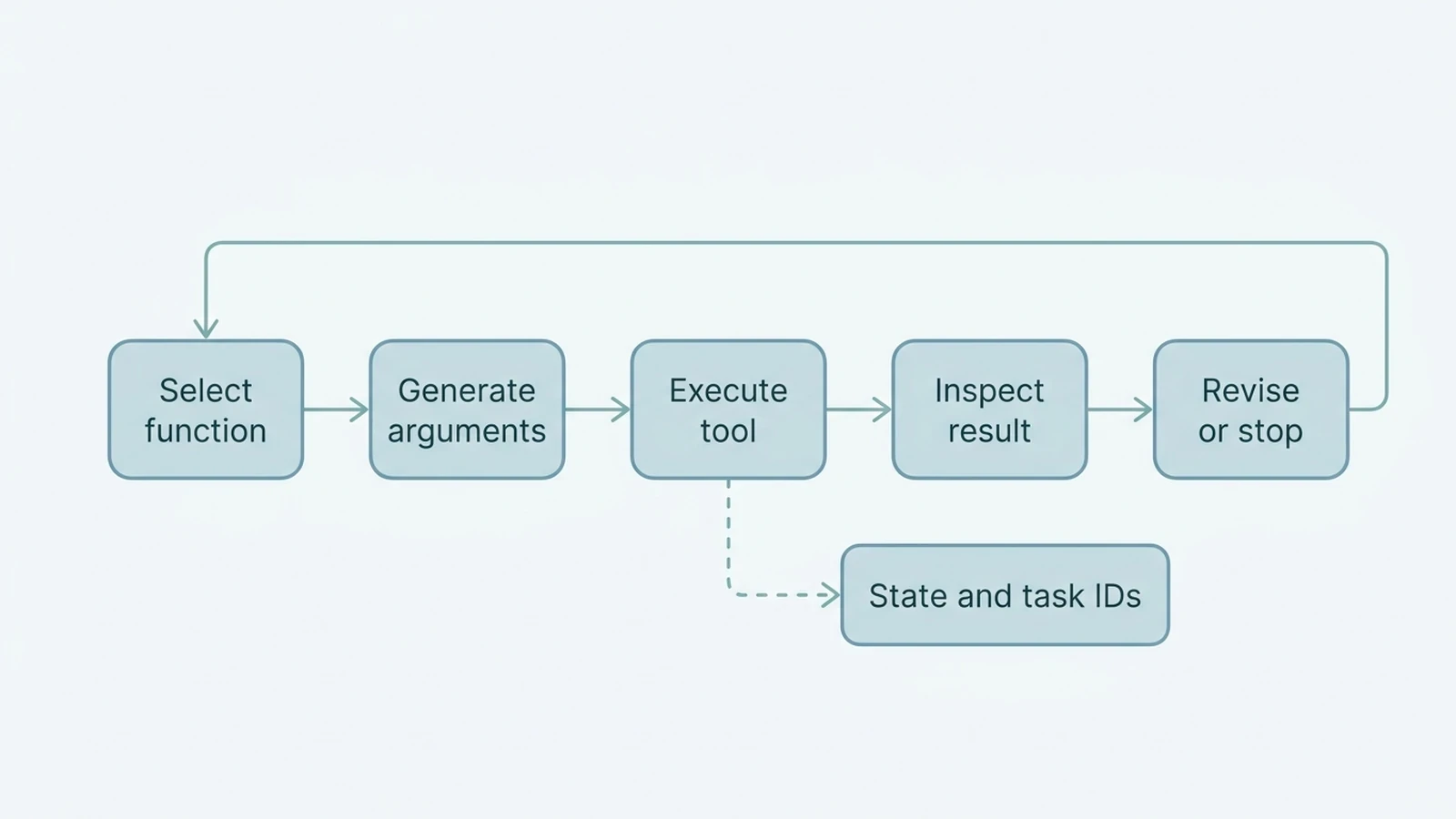
Generated tool arguments should always be validated before execution. Enforce expected types, reject unknown fields, restrict accessible paths, and limit commands, retries, and external requests. These controls are necessary even when a model achieves a high tool-use benchmark score.
State management also affects the result. A long context window can preserve more repository content and tool history, but an agent still needs to identify which information remains relevant. Store important decisions and test results explicitly instead of expecting the model to recover them from a large undifferentiated transcript.
For a useful comparison, divide the evaluation into at least two task groups:
Coding tasks, such as fixing tests, implementing features, and refactoring several modules.
Agent tasks, such as collecting information, calling multiple tools, changing external state, and verifying the final outcome.
This separation shows whether failures originate in code generation, tool orchestration, state management, or final verification.
API Cost and Latency on Comparable Workloads
The current SiliconFlow Serverless pricing gives DeepSeek V4 Pro the lower per-token rate in all three billing categories.
Token Category | DeepSeek V4 Pro | GLM 5.3 |
|---|---|---|
Uncached input | $1.32/M | $1.40/M |
Cached input | $0.044/M | $0.26/M |
Output | $3.96/M | $4.40/M |
For equal token usage, DeepSeek V4 Pro’s uncached input price is about 5.7% lower, while its output price is 10% lower. Its cached-input rate is about 83.1% lower.
The request-cost formula is:
Request cost = uncached input cost + cached input cost + output cost
Consider a hypothetical batch of 1,000 coding-agent tasks. Each task processes 50,000 input tokens and generates 10,000 output tokens.
Scenario | DeepSeek V4 Pro | GLM 5.3 |
|---|---|---|
No cached input | 0.05 × $1.32 + 0.01 × $3.96 = $0.1056 per task$105.60 for 1,000 tasks | 0.05 × $1.40 + 0.01 × $4.40 = $0.114 per task$114.00 for 1,000 tasks |
40,000 cached input tokens | 0.01 × $1.32 + 0.04 × $0.044 + 0.01 × $3.96 = $0.05456 per task$54.56 for 1,000 tasks | 0.01 × $1.40 + 0.04 × $0.26 + 0.01 × $4.40 = $0.0684 per task$68.40 for 1,000 tasks |
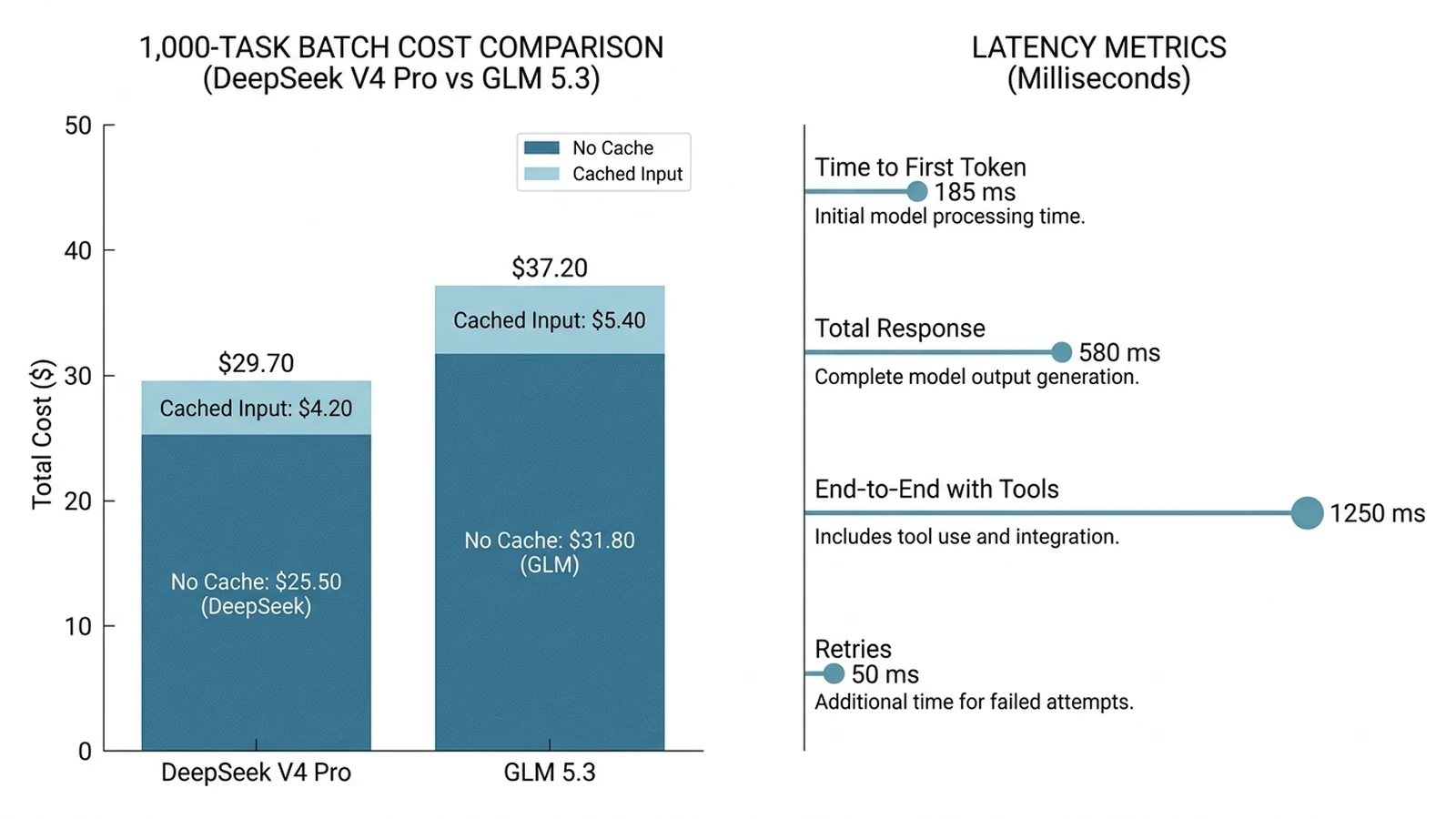
The second scenario assumes that 40,000 tokens in each request qualify for cached-input billing. Actual eligibility and hit rates depend on the request structure and platform behavior.
These figures also assume that both models use the same number of tokens and complete every task successfully. Real coding agents may produce different output lengths, make additional tool calls, or retry failed work.
Token price should therefore be evaluated alongside cost per accepted task:
Cost per accepted task = total API and retry spend ÷ tasks that pass validation
Suppose GLM 5.3 costs more per request but completes significantly more difficult tasks without intervention. Its effective cost could be lower. If its pass rate is similar, DeepSeek V4 Pro’s lower rates become more important.
Latency should be measured with the same workload-level approach. Parameter counts and benchmark rankings do not establish how quickly a hosted endpoint will finish a task. Record:
Median and P95 time to first token.
Median and P95 total response time.
End-to-end time including tools and tests.
Output tokens generated per task.
First-pass completion rate.
Tool-call validation failures.
Retries required before acceptance.
Cost per accepted result.
Keep repository snapshots, prompts, tools, output limits, timeouts, and acceptance tests consistent. Run each task more than once because agent behavior and endpoint performance can vary between requests.
Which Model Fits Your Coding Workflow?
Choose DeepSeek V4 Pro as the first model to test when:
You expect a high volume of coding requests.
The same system prompt, tool definitions, or repository context will be reused.
Input and output cost must remain predictable.
Repository implementation and tool use are central to the workflow.
The model will serve as the default tier in a routed system.
Choose GLM 5.3 as the first model to test when:
Tasks regularly span several files or modules.
The agent must work through extended implementation and verification loops.
DeepSWE-style engineering work resembles your production workload.
Workflow automation matters as much as code generation.
A higher completed-task rate could justify a higher token price.
A routed system can use both models without treating either one as the answer to every task. Begin with DeepSeek V4 Pro for predictable, high-volume work. Escalate failed or unusually complex tasks to GLM 5.3 when your evaluation shows that it improves completion rates.
Build the routing rule from real results. A practical evaluation set can contain 30 to 100 representative tasks divided by language, repository size, complexity, and required tool use. Score each output with tests or explicit acceptance criteria rather than subjective preference.
The DeepSeek V4 Pro vs. GLM 5.3 decision ultimately comes down to verified task economics. DeepSeek V4 Pro offers the lower current API prices on SiliconFlow. GLM 5.3 shows stronger vendor-reported results on several long-horizon coding and agent benchmarks. Choose the model that produces more accepted work at an acceptable latency and total cost.
Common Questions About DeepSeek V4 Pro vs. GLM 5.3 at a Glance
Q1. Are DeepSeek V4 Pro and GLM 5.3 Open-Weight Models?
Yes. Both publish downloadable weights. DeepSeek-V4-Pro-0813 uses the MIT License, while GLM 5.3 uses its own named model license. Review the applicable terms before modifying, redistributing, or commercially self-hosting either model.
Q2. Can DeepSeek V4 Pro and GLM 5.3 Process Images on SiliconFlow?
No. Their current SiliconFlow deployments accept text input. A workflow that depends on screenshots, diagrams, or rendered interfaces should send those assets to a supported vision model before passing the relevant findings to the coding agent.
Q3. Does a One-Million-Token Context Window Replace Code Retrieval?
No. A larger window increases capacity but does not guarantee that every file receives equal attention. Repository maps, dependency-aware retrieval, targeted file selection, and context compaction can improve relevance while reducing token use.
Q4. Can You Switch Between the Models Through the Same API Integration?
Yes. Both are accessible through SiliconFlow’s OpenAI-compatible API using different model IDs. Keep model-specific request settings and output handling configurable, then rerun validation tests whenever you change the model or version.
Q5. How Should a Coding Agent Handle an HTTP 429 Response?
Reduce concurrency and retry with exponential backoff and jitter. SiliconFlow’s documented 429 example identifies a token-per-minute limit, but applications should inspect the returned message before deciding whether and when to retry.