MiniMax M2.1 on SiliconFlow: Enhanced Multi-Language Programming, Built for Real-World Complex Tasks
Table of Contents
TL;DR: MiniMax M2.1 is now live on SiliconFlow. Built for real-world complex tasks, it delivers exceptional multi-language programming capabilities, enhanced office scenario support and superior web/app development performance. With strengthened composite instruction handling and more concise responses, M2.1 also excels at agent scaffolding and maintains high-quality dialogue generation. Start building production-ready applications today with SiliconFlow's API.
MiniMax M2.1 is now available on SiliconFlow. Built to handle real-world development complexity, M2.1 brings enhanced multi-language programming support and practical office automation capabilities. It tops the charts on SWE-Bench, VIBE, and Multi-SWE, outperforming both Gemini 3 Pro and Claude Sonnet 4.5 on coding tasks. With a 197K context window and MoE architecture (10B active / 230B total parameters), M2.1 gives developers the tools they need for cross-platform projects and workflow automation.
Available now through SiliconFlow's API:
Accessible Pricing:
$0.29/1M tokens (input) and $1.20/1M tokens (output)
197K Context Window: Work with large codebases, multi-file projects, and extended document processing tasks.
Works With Your Tools: Performs consistently across Claude Code, Cline, Kilo Code, Roo Code, BlackBox, and Droid. Supports context management patterns like Skill.md, Claude.md/agent.md/cursorrule, and Slash Commands.
Programming Languages Support: Rust, Java, Golang, C++, Kotlin, Objective-C, TypeScript, JavaScript, and more.
Whether you're building websites, mobile applications, or data analysis tools, M2.1 handles multi-language projects, office workflows, and cross-framework development.
What's new in M2.1?
For developers working across multiple programming languages or building office automation workflows, the gap between "AI that codes" and "AI that handles real production complexity" has always been frustrating. MiniMax M2.1 bridges this gap: instead of optimizing primarily for Python, it delivers enhanced performance across Rust, Java, Golang, C++, and beyond—while understanding the composite constraints that real office tasks actually involve.
Below, we'll break down the specific capabilities that make this possible, plus share recommended settings to help you get the most out of M2.1 on SiliconFlow.
Key Highlights
Built for Real-World Development (Multi-language + Web/App)
Real-world projects rarely stick to one language. M2.1 supports production-grade languages including Rust, Java, Golang, C++, Kotlin, Swift/Objective-C, TypeScript, and JavaScript—making it practical to use across frontend, mobile, and backend workflows. It also improves Web and App development quality, from UI logic and complex interactions to production-ready “vibe coding” you can actually ship.
Better at Handling Complex Instructions
Office tasks often involve multiple constraints at once—data, structure, tone, and logic. M2.1 follows multi-step, composite instructions more consistently, reducing drift and making it more reliable for reports, documentation, and everyday professional workflows.
Faster & More Efficient
Compared to M2, M2.1 delivers more concise outputs, faster response times, and lower token usage—resulting in smoother experiences for AI coding, agents, and long-running workflows.
Strong Compatibility with Agent and Tooling Ecosystems
M2.1 performs consistently across popular tools and agent frameworks such as Claude Code, Cline, Roo Code, Kilo Code, BlackBox, and others, while supporting common context and rule systems like Skill.md, Claude.md/agent.md/cursorrule, and Slash Commands.
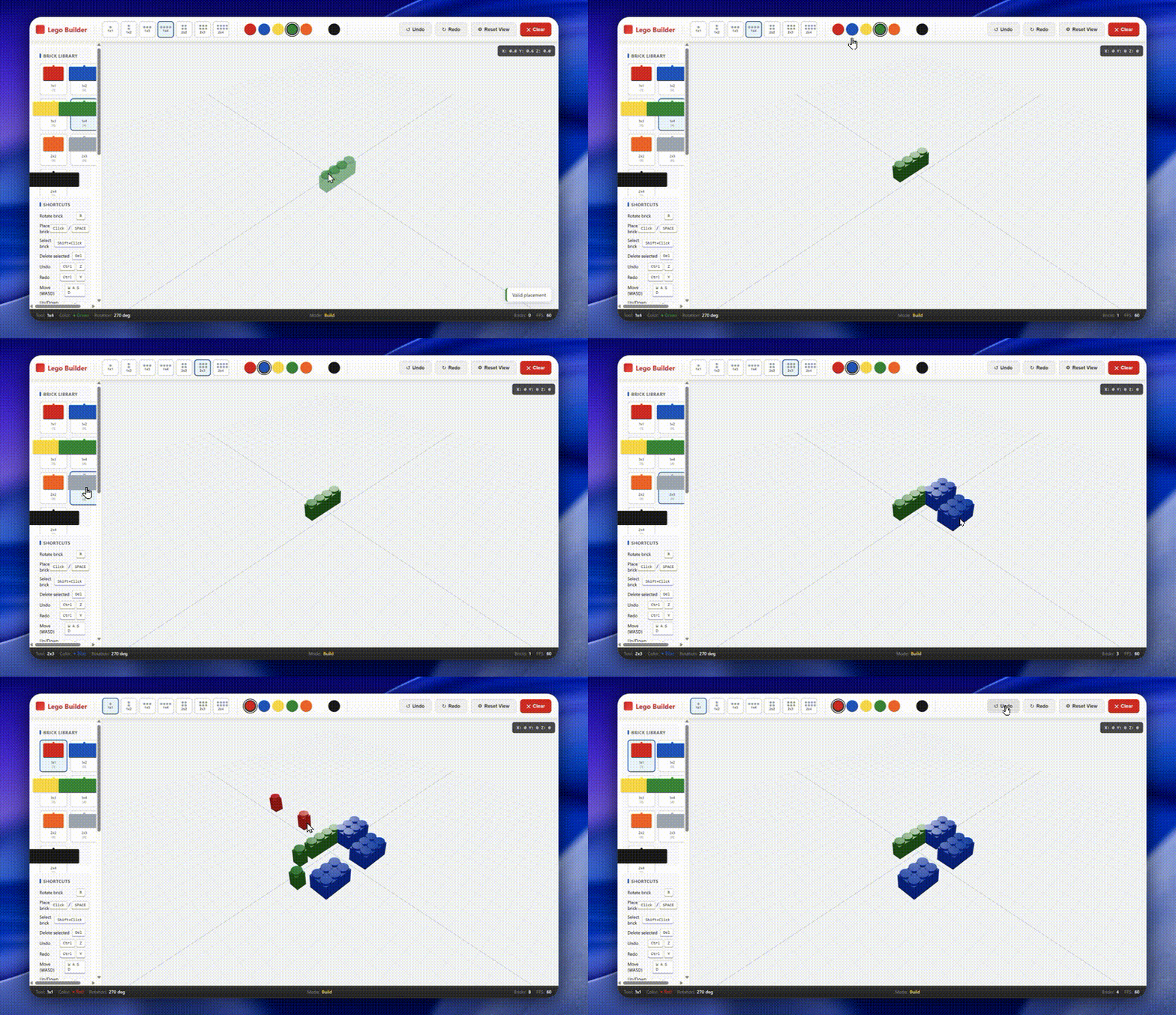
Using MiniMax M2.1 via the SiliconFlow API in Claude Code, we built a fully interactive Three.js-based 3D Lego Builder demo. It highlights M2.1's strong capabilities in agent-style task orchestration and complex logic handling — autonomously implementing key features such as grid snapping, collision detection, and state management.
Benchmark Performance
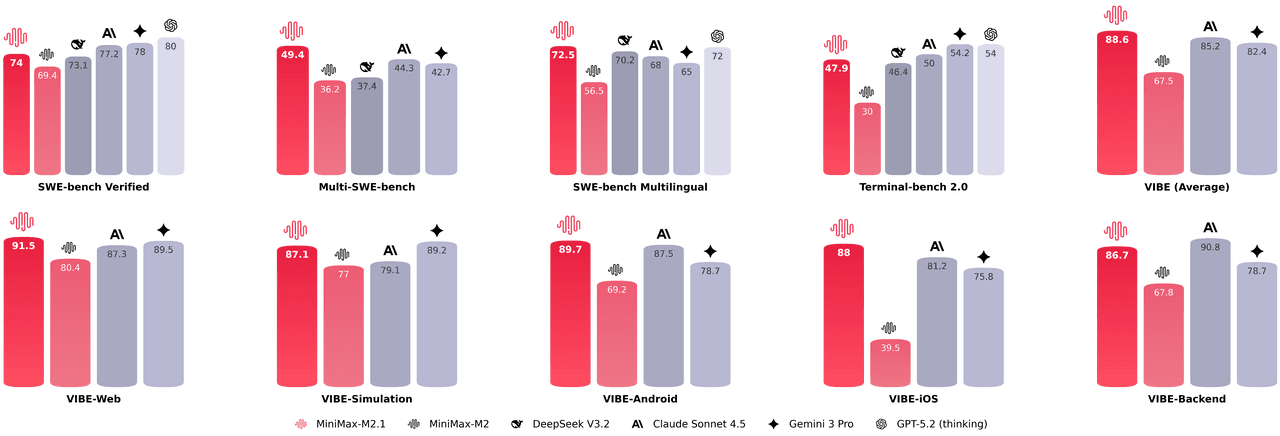
MiniMax-M2.1 delivers a significant leap over M2, especially on core software engineering leaderboards. It shines particularly bright in multilingual scenarios, where it outperforms Claude Sonnet 4.5 and closely approaches Claude Opus 4.5.
Software Engineering
Shows strong framework generalization and stability across SWE-bench Verified
Matches or exceeds Claude Sonnet 4.5 in specialized domains: test case generation, code optimization, code review, and instruction following
Full-Stack Development (VIBE)
Average score of 88.6, excelling in VIBE-Web (91.5) and VIBE-Android (89.7)
Overall Improvements
Steady enhancements in long-horizon tool use and comprehensive intelligence metrics
M2.1 Recommended Settings
To get the best results from M2.1, we recommend starting with these parameters:
Use temperature 0.7-0.8 for production code that needs to be reliable and consistent. Stick with 1.0 when prototyping or exploring multiple solution paths. These settings work well as a starting point—adjust based on your specific workflow and task complexity.
Get Started Immediately
Explore: Try MiniMax M2.1 in the SiliconFlow playground.
Integrate: Use our OpenAI-compatible API. Explore the full API specifications in the SiliconFlow API documentation.