目錄

TL;DR:
GLM-5.2 is Z.ai's latest open-source flagship, now live on SiliconFlow.
Features: Frontier-level coding, agentic, and long-horizon performance: it matches or beats GPT-5.5 on several public benchmarks (FrontierSWE, SWE-bench Pro, MCP-Atlas) and lands within ~1–4 points of Claude Opus 4.8 on coding and agentic tasks.
Cost on SiliconFlow: Less than a quarter of Opus 4.8's cost per long-horizon task.
Get started: OpenAI- and Anthropic-compatible APIs drop into Claude Code, Cline, Hermes Agent, OpenCode and your existing tools in minutes.
For developers using AI models, the trade-off has been clear: pay a premium for frontier closed-source models, or compromise on capability with open alternatives.
GLM-5.2 changes that. Z.ai's latest open-source flagship delivers frontier-level coding and long-horizon task execution with usable 1M context window, matching Opus 4.8, GPT 5.5 and even Fable 5 — all while costing less than a quarter as much per long-horizon task.
Now available on SiliconFlow, GLM-5.2 gives builders frontier-level coding within reach: competitive with GPT-5.5, close to Opus 4.8 on many tasks, all at a fraction of the cost.
GLM-5.2 on SiliconFlow | |
Context window | 1049K tokens |
Input | $ 1.40 / M tokens |
Output | $ 4.40 / M tokens |
Cache read | $0.26 / M tokens |
Capabilities | Function Calling · Context Caching · Thinking · Dual Reasoning effort |
Precision | FP8 |
Why GLM-5.2 stands out
Usable 1M Context: A million-token context that can reliably sustain project-scale codebases and long-running engineering workflows, not just accept longer prompts.
Built for Long-Horizon Engineering: Designed to stay on track across implementation, debugging, optimization, and research tasks, allowing complex engineering work to be completed within a single workflow.
Flexible Reasoning, Production-Ready Coding: High and Max reasoning modes let you balance latency, cost, and coding quality for different workloads, while architectural improvements keep million-token inference practical and efficient.
From benchmarks to real engineering
Capability claims are only meaningful if they hold up under evaluation.
Across public benchmarks, GLM-5.2 is the strongest open-source model available today and sits within striking distance of the closed-source frontier across long-horizon engineering, coding, and agentic tasks.
Benchmark performance
Category | Benchmark | GLM-5.2 | GLM-5.1 | Opus 4.8 | GPT-5.5 | Note |
Long-horizon | FrontierSWE | 74.4 | 30.5 | 75.1 | 72.6 | Beats GPT-5.5 by 1.8 points |
PostTrainBench | 34.3 | 20.1 | 37.2 | 28.4 | 2nd only to Opus 4.8 | |
SWE-Marathon | 13.0 | 1.0 | 26.0 | 12.0 | Surpass GPT-5.5 | |
Coding | Terminal-Bench 2.1 | 81.0 | 63.5 | 85.0 | 84.0 | Within 4 points of Opus 4.8 |
SWE-bench Pro | 62.1 | 58.4 | 69.2 | 58.6 | Beats GPT-5.5 by 3.5 points | |
Agentic | MCP-Atlas | 76.8 | 71.8 | 77.8 | 75.3 | Within 1 point of Opus 4.8 |
Tool-Decathlon | 48.2 | 40.7 | 59.9 | 55.6 | Largest gap to Opus 4.8 in this table | |
Third-party | #2 | #9 | #4 | Top available (Fable 5 export-restricted for non-US users) | ||
#1 | #6 | #19 | Beats Fable 5, Opus 4.6 & 4.7 | |||
1266 Elo | 1356 Elo | 1159 Elo | ~90 below Opus 4.8, <25% of the cost |
Real-world Performance
To understand what GLM-5.2 actually feels like to build with, we compared it against GPT-5.5 and Claude Opus 4.8 using the exact same prompts under identical conditions.
This isn't about declaring a winner. It's about showing where GLM-5.2 reaches frontier-level performance, where it stands out, and where trade-offs remain.
What stood out
All four models produced runnable HTML on the first try. But GLM-5.2 showed a clear leap over GLM-5.1 in composition, interaction, and polish.
The biggest difference appeared in “Light & Shadow.” GLM-5.2 turned the prompt’s “slow, weighted, architectural motion” into a dynamic sun-and-shadow system. Claude Opus 4.8 handled this well too, while GPT-5.5 took a more conservative, card-based approach.
On this task, GLM-5.2 came close to Claude Opus 4.8 in output quality, while being about 3.6x cheaper on input and 5.7x cheaper on output on SiliconFlow.
For visual interfaces, landing pages, prototypes, and interactive demos, GLM-5.2 offers a compelling balance of frontend coding ability, design judgment, and cost efficiency.
Run GLM-5.2 with Your Existing Tools
Numbers and demos can only tell you so much — the fastest way to know if GLM-5.2 fits your workflow is to run it yourself. And that only takes minutes.
Try it first, no setup
Open the SiliconFlow Playground and chat with GLM-5.2 right in your browser.
Tune temperature, top-p, and reasoning effort (High / Max), or run two models side by side on the same prompt — put GLM-5.2 next to GLM-5.1 and see the jump for yourself.
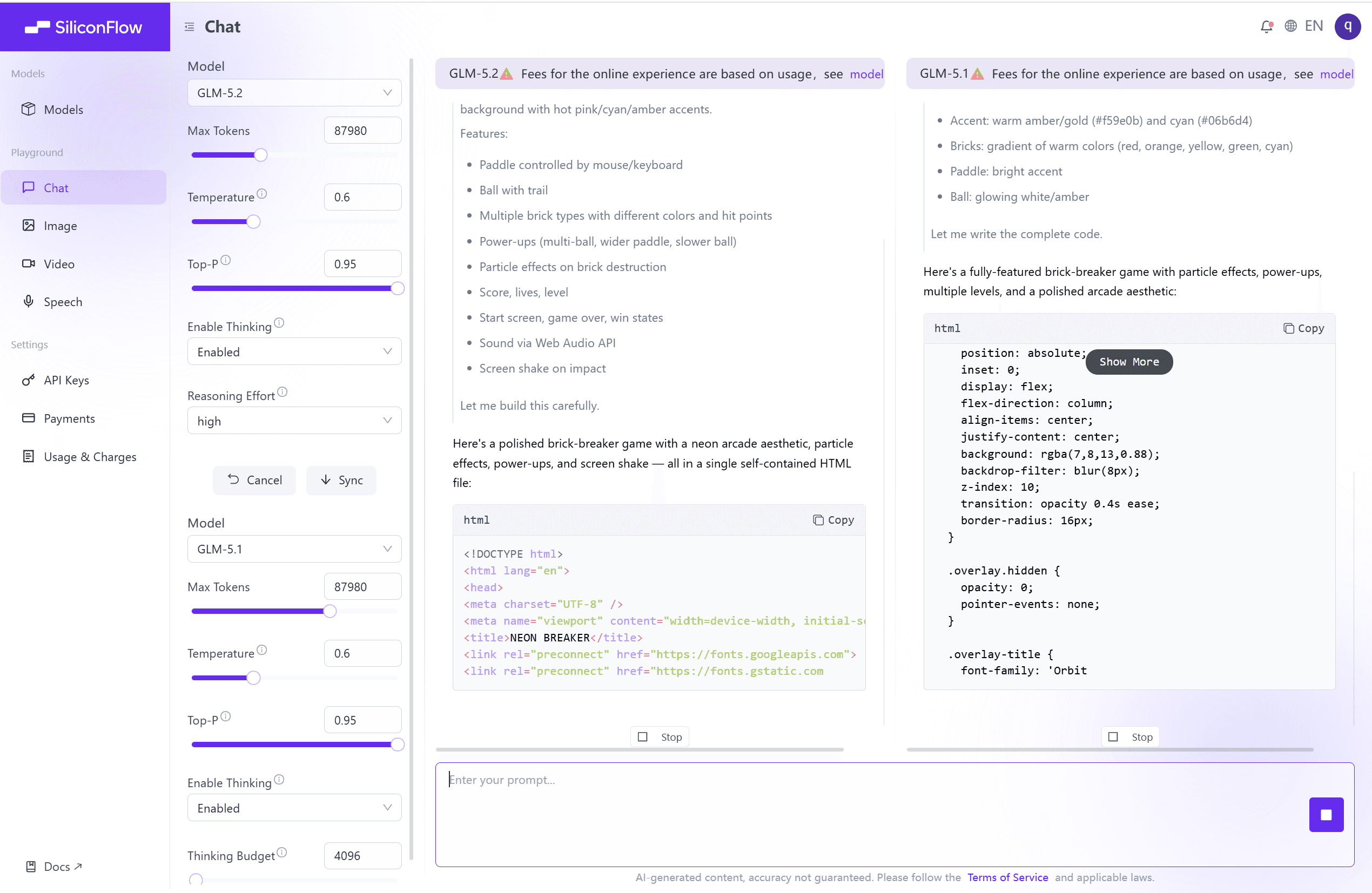
Plug into your tools
SiliconFlow APIs are both OpenAI- and Anthropic-compatible, so GLM-5.2 drops straight into any tool that supports a custom provider — same SDK, same code, just a new base URL and model string. Live in minutes.
Tool | SiliconFlow Integration Guide |
Claude Code | |
Cline | |
OpenCode | Open-source AI coding agent for flexible development workflows |
Hermes Agent | |
SillyTavern | |
And more |
What you need to connect:
Base URL | https://api.siliconflow.com or https://api.siliconflow.com/v1 |
SiliconFlow API Key | |
Model string | zai-org/GLM-5.2 |
Get Started Immediately
Build: Try GLM-5.2 on SiliconFlow through the playground.
Integrate: Use our OpenAI-compatible API. Explore the full API specifications in the SiliconFlow API documentation.
Join our Discord community now →