Ring-1T Now on SiliconFlow: The World's First Open-Source Trillion-Parameter Thinking Model
Table of Contents
TL;DR: Ring-1T — the world's first open-source trillion-parameter thinking model — is now live on SiliconFlow. Built on Ling 2.0 architecture (1T total / 50B active parameters, 131K context), it introduces the Icepop algorithm and ASystem for stable large-scale reinforcement learning across MoE models. Achieving silver-medal-level performance at IMO 2025, Ring-1T sets a new benchmark for open-source deep reasoning.
Now, start building with Ring-1T today through SiliconFlow's production-ready API!
Today, we're excited to bring Ring-1T to SiliconFlow — the first open-source trillion-parameter thinking model developed by Ant Group's inclusionAI team. Following the success of Ling-1T, Ring-1T extends the Ling 2.0 architecture to trillion scale, combining dense-level reasoning quality with efficient MoE activation. With the newly introduced Icepop algorithm and ASystem for stable large-scale reinforcement learning, it pushes open-source deep reasoning to a new frontier — from mathematics and programming to complex natural-language inference.
With SiliconFlow's Ring-1T API, you can expect:
Competitive Pricing: $0.57/M tokens (input) and $2.28/M tokens (output).
Trillion-Parameter MoE Architecture: 1T total parameters with ~50B active per token, delivering dense-level reasoning power with efficient resource utilization.
Stable Reinforcement Learning: Powered by the Icepop algorithm and ASystem, enabling smooth, long-term RL training across trillion-scale MoE models.
Advanced Reasoning & Math: Achieves silver-medal-level performance at IMO 2025, demonstrating world-class mathematical and logical reasoning ability.
131K Context Window: Supports long-context document analysis and multi-turn reasoning with stable performance and low latency.
Whether you're developing analytical systems, educational applications, or reasoning-based agents, you can now access Ring-1T directly through SiliconFlow's API to power your next-generation solutions.
Why Ring-1T Matters
Evolved Deep Reasoning Capabilities
Developed by Ant Group's inclusionAI team, Ring-1T represents a new milestone in trillion-scale reasoning.
Compared to its preview version, it delivers more balanced and robust performance across mathematics, programming, and logical reasoning — achieving state-of-the-art open-source results on leading benchmarks including AIME 25, HMMT 25, LiveCodeBench, CodeForce, ARC-AGI-1, and Arena-Hard-v2.0.
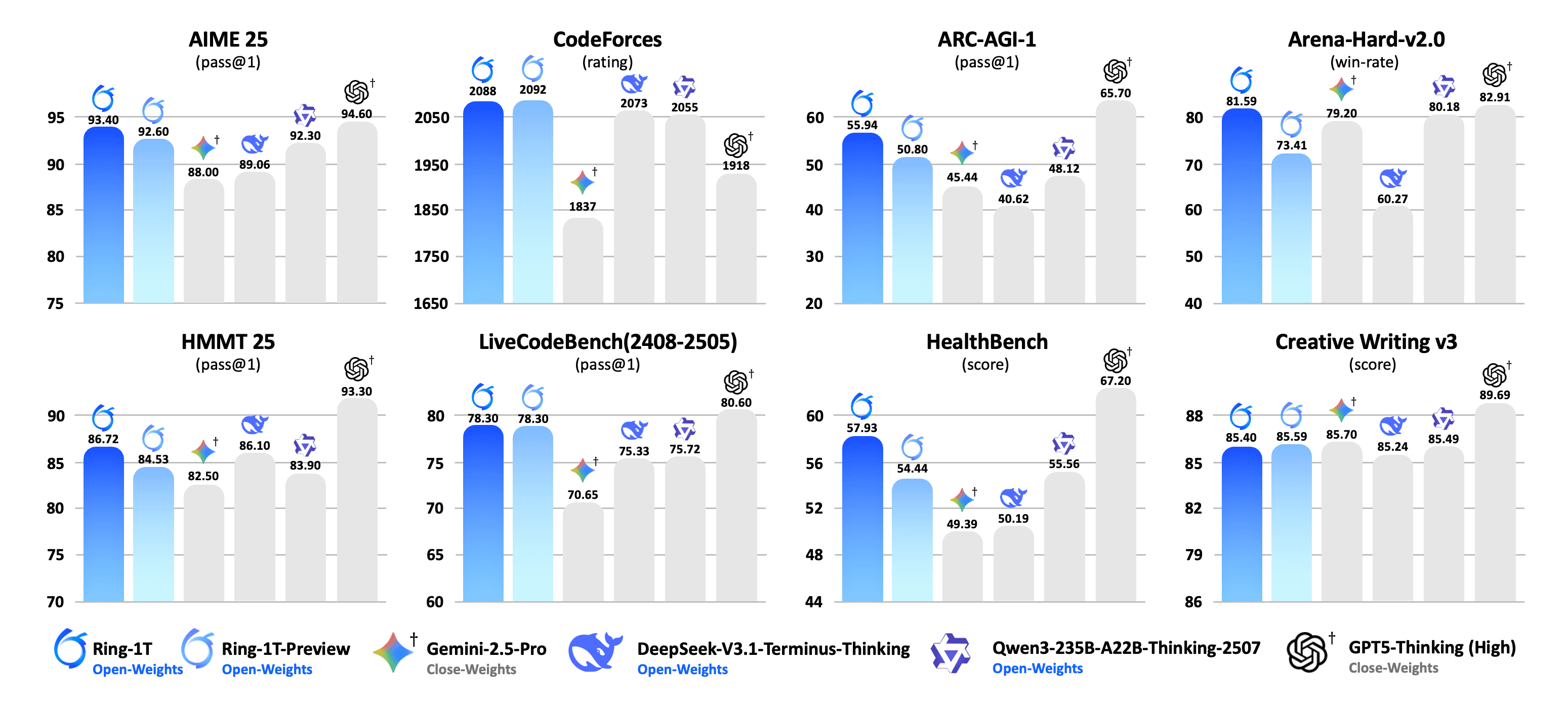
To ensure fairness, Ring-1T underwent string and semantic decontamination throughout pre-training, fine-tuning, and reinforcement-learning stages.
Its results on IMO 2025 and ICPC World Finals 2025 further validate its deep reasoning strength, with the model reaching silver-medal-level mathematical performance and solving five of twelve ICPC problems — rivaling top closed-source systems like Gemini-2.5-Pro and GPT-5-Thinking.
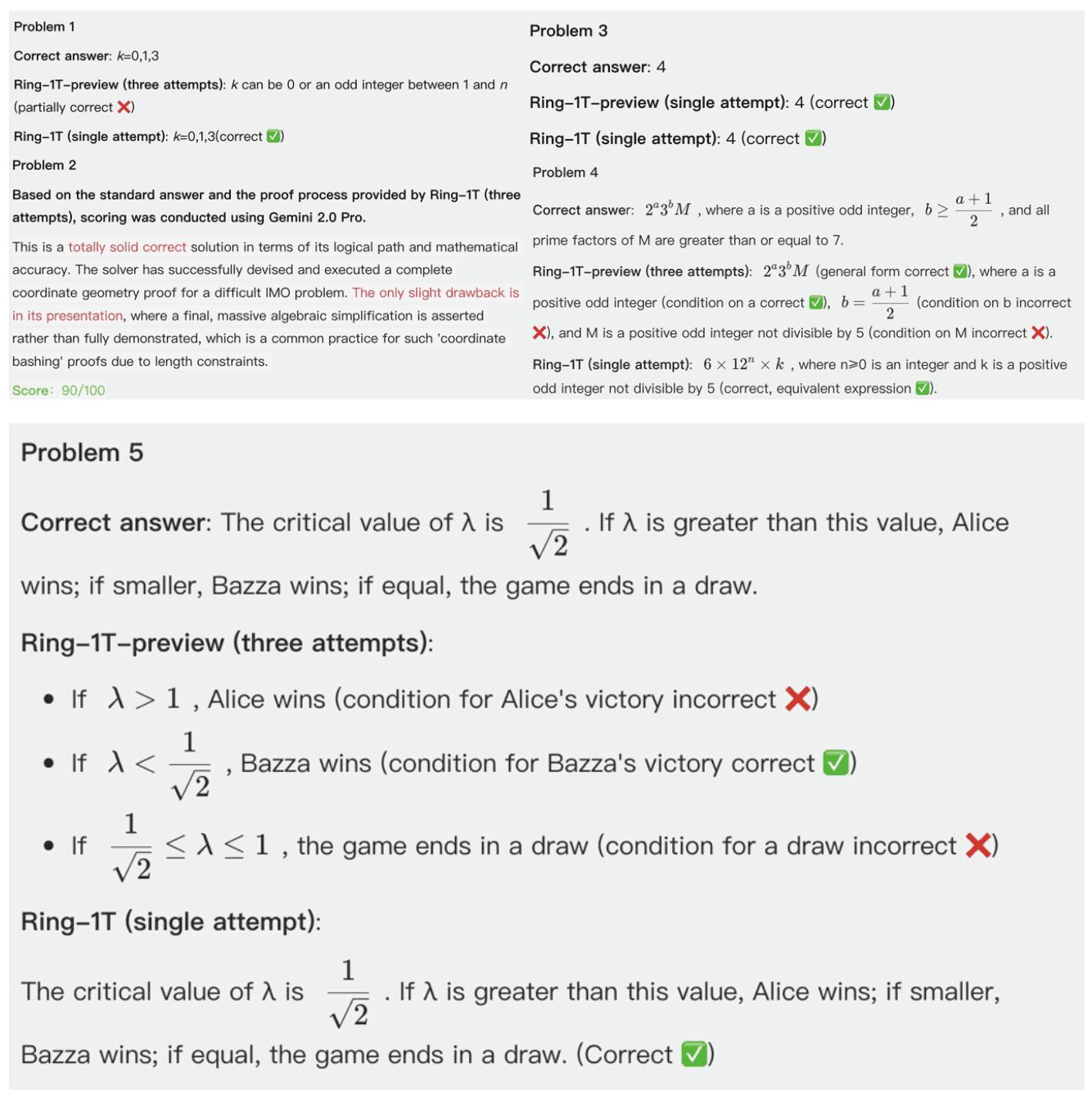
To see how Ring-1T handles mathematical reasoning in practice, we gave it a logic-based coordinate problem. It broke down the conditions step by step, explained its reasoning clearly, and reached the correct answer with full consistency — a concise example of its structured and transparent thought process.
Prompt and reasoning demo below:

Stable Reinforcement Learning with Icepop
Ring-1T achieves its exceptional performance through the inclusionAI team's Icepop algorithm and ASystem, a self-developed reinforcement-learning infrastructure purpose-built for trillion-parameter MoE models.
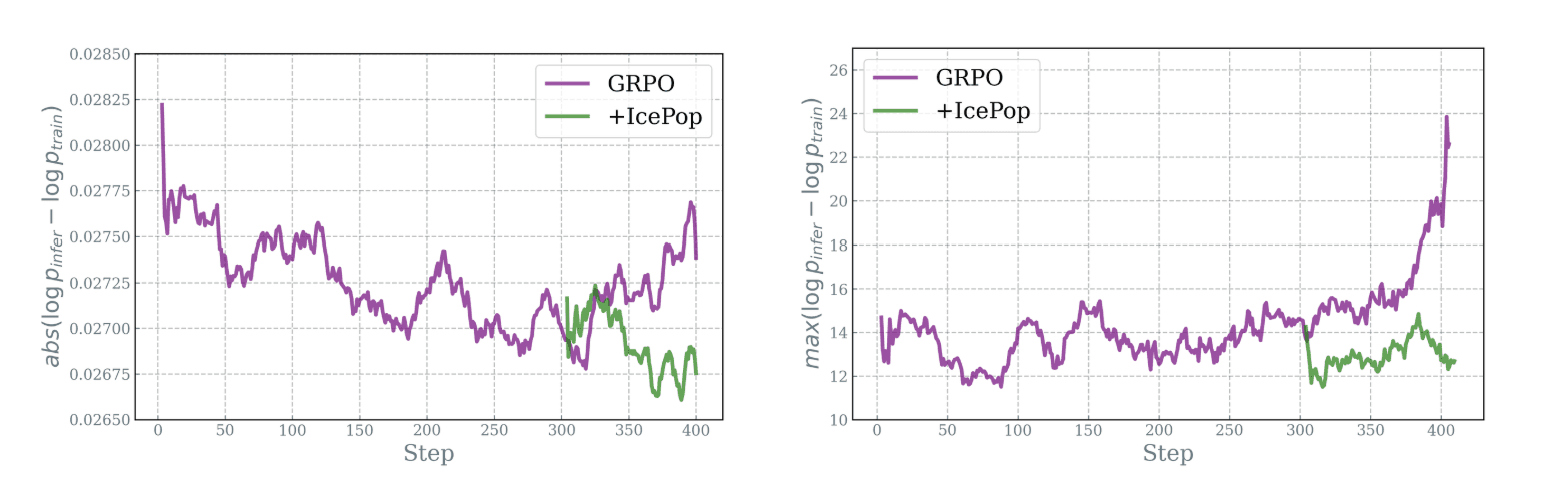
Icepop introduces masked bidirectional truncation correction, effectively narrowing the gap between training and inference and preventing the collapse seen in traditional GRPO algorithms.
This ensures long-term stability and consistent reasoning quality, even in extended training cycles.
Real-world Application Scenarios
Powered by trillion-scale reasoning and long-context understanding, Ring-1T helps developers, researchers, and enterprises tackle real-world tasks that demand accuracy, consistency, and deep analytical capability.
Complex Problem Solving & Analytical Reasoning Use Ring-1T to handle advanced logic or quantitative tasks — from mathematical proof generation to structured analytical reports — with explainable reasoning chains and step-by-step clarity.
Code Intelligence & System Optimization Integrate Ring-1T into your development workflows for multi-step code generation, debugging, and algorithm design. Its strong performance on LiveCodeBench and ICPC 2025 ensures reliable reasoning for production-grade coding agents.
Agentic Workflows & Autonomous Planning Build capable AI agents that can plan, reason, and make decisions autonomously. Ring-1T's 131K context window and stable RL backbone enable consistent, multi-turn reasoning in complex real-world environments.
Education & Knowledge-Driven Applications Power intelligent tutoring, training, or knowledge-assessment systems that explain logical and mathematical reasoning clearly — ideal for educational platforms and enterprise learning tools.
From advanced research to real-world deployment, Ring-1T brings deep reasoning and reliable intelligence to the next generation of applications — now fully available through SiliconFlow’s production-ready API.
Get Started Immediately
Explore: Try Ring-1T in the SiliconFlow playground.
Integrate: Use our OpenAI-compatible API. Explore the full API specifications in the SiliconFlow API documentation.
Ready to explore trillion-scale reasoning?
Access Ring-1T now on SiliconFlow and integrate deep, interpretable intelligence directly into your workflows.