Table of Contents

TL;DR:
Kimi K2.7 Code is Moonshot AI's latest open-source, coding-focused agentic model, now live on SiliconFlow.
Features: Built on Kimi K2.6, Kimi K2.7 Code is a coding-focused agentic model with substantial improvements on real-world long-horizon coding tasks, stronger end-to-end task completion, more reliable instruction-following in long contexts, and ~30% lower thinking-token usage than its predecessor.
Cost on SiliconFlow:
$0.94 / M input · $4.00 / M output · $0.19 / M cache read
Get started: SiliconFlow offers OpenAI- and Anthropic-compatible APIs, so you can integrate into Claude Code, Cline, Hermes Agent, OpenCode and your existing tools in minutes.
For developers building agentic coding workflows, the real cost isn't just per-token price — it's how many tokens a model burns "thinking" before it acts, and whether it stays on track across a long, multi-step task.
Kimi K2.7 Code is built for exactly that. Moonshot AI's latest open-weight, coding-focused flagship is built on top of Kimi K2.6 and tuned for real-world long-horizon software engineering: planning, editing across many files, running tools, and debugging its own work across extended sessions — while spending roughly 30% fewer reasoning tokens than K2.6.
Now available on SiliconFlow, Kimi K2.7 Code gives builders a strong open-source coding model with leading tool-use reliability, native multimodal input, and a Modified MIT license — at a fraction of closed-model cost.
Kimi K2.7 Code on SiliconFlow | |
Context window | 262K tokens |
Input | $ 0.94 / M tokens |
Output | $ 4.00 / M tokens |
Cache read | $ 0.19 / M tokens |
Capabilities | Function Calling · Context Caching · Image Input |
Precision | FP8 |
Why Kimi K2.7 Code stands out
Built for Long-Horizon Coding: Optimized for multi-step engineering work — refactoring across files, implementing features end-to-end, and debugging over long agent sessions — with more reliable instruction-following as context grows and higher end-to-end task success rates than K2.6.
Leading Tool-Use Reliability: On MCP Mark Verified — which measures correct tool invocation across real server environments — K2.7 Code scores 81.1, ahead of Claude Opus 4.8 (76.4). For agentic loops that chain edits, shell commands, and API calls, reliable tool use is what keeps a workflow from breaking mid-task.
Efficient Reasoning, Less Overthinking: ~30% lower thinking-token usage than K2.6 at higher benchmark scores — meaning faster interactive responses, lower production cost, and more useful work completed within the same context budget.
Natively Multimodal: Text plus image (and video via the official Kimi API) through a 400M-parameter MoonViT vision encoder — hand it a UI screenshot to debug a layout, or a recorded repro alongside a stack trace.
From benchmarks to real engineering
Capability claims are only meaningful if they hold up under evaluation.
Kimi K2.7 Code was evaluated against K2.6 across two dimensions — coding capability and agentic task execution — on a mix of Moonshot's internal and external benchmarks. The headline story is a clear generational jump over K2.6 and best-in-class open-source tool use, rather than an across-the-board lead over the closed frontier.
Benchmark performance
Benchmark | Kimi K2.7 Code | Kimi K2.6 | GPT-5.5 | Claude Opus 4.8 | Note |
Coding | |||||
Kimi Code Bench v2 | 62 | 50.9 | 69 | 67.4 | +21.8% over K2.6 |
Program Bench | 53.6 | 48.3 | 69.1 | 63.8 | +11.0% over K2.6 |
MLS Bench Lite | 35.1 | 26.7 | 35.5 | 42.8 | +31.5% over K2.6; ~ GPT-5.5 |
Agentic | |||||
Kimi Claw 24/7 Bench | 46.9 | 42.9 | 52.8 | 50.4 | ~10% gain over K2.6 |
MCP Atlas | 76 | 69.4 | 79.4 | 81.3 | Closes gap to frontier |
MCP Mark Verified | 81.1 | 72.8 | 92.9 | 76.4 | Beats Opus 4.8 on tool use |
Methodology note (from Moonshot): Kimi Code Bench v2 and Kimi Claw 24/7 Bench are Moonshot in-house benchmarks. Full per-benchmark methodology and details is in the Hugging Face model card.
Optimized reasoning efficiency
The most operationally meaningful number isn't a benchmark score — it's the ~30% reduction in thinking tokens versus K2.6, achieved while scoring higher.
Reasoning models tend to overthink, spending thousands of tokens deliberating on problems that don't need it. In an agentic coding session that runs hundreds or thousands of steps, that overhead compounds: every plan, retry, and verification pass pays the thinking tax again. K2.7 Code cuts that tax across the board — Moonshot reports higher scores than K2.6 on Kimi Code Bench v2, Program Bench, and MLS Bench Lite at lower token consumption on each.
Each arrow traces the shift from K2.6 to K2.7 Code. Up means higher performance; left means fewer tokens. K2.7 Code lands up-and-left on every benchmark — the rare case where a model gets both better and cheaper at once. For developers, this compounds across every task: faster responses in interactive coding, lower API cost in production, and agent workflows that finish more work within the same context budget.
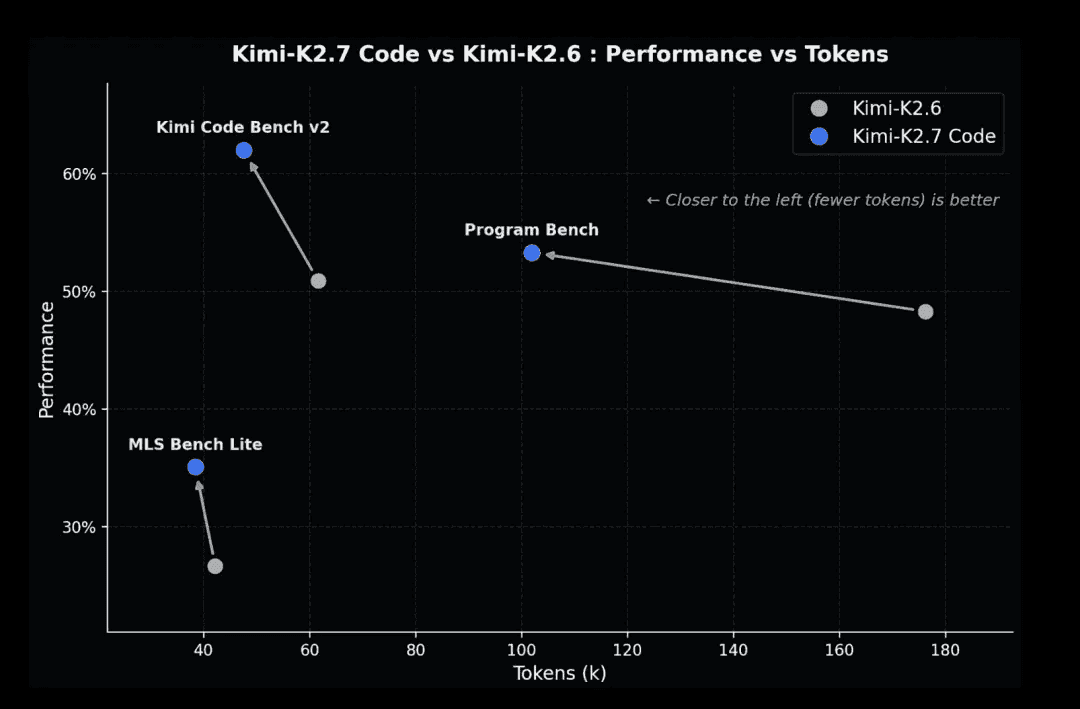
Performance vs Tokens — across all three coding benchmarks, Kimi K2.7 Code (blue) moves up and to the left of K2.6 (grey): higher scores while spending fewer tokens. The biggest efficiency gain is on Program Bench, where K2.7 Code matches a higher score at roughly 40% fewer tokens.
Run Kimi K2.7 Code with Your Existing Tools
Numbers and benchmarks can only tell you so much — the fastest way to know if Kimi K2.7 Code fits your workflow is to run it yourself. And that only takes minutes.
Try it first, no setup
Open the SiliconFlow Playground and chat with Kimi K2.7 Code right in your browser.
Tune temperature and top-p, or run two models side by side on the same prompt — put K2.7 Code next to K2.6 and see the jump in performance for yourself.
Plug into your tools
SiliconFlow APIs are both OpenAI- and Anthropic-compatible, so Kimi K2.7 Code drops straight into any tool that supports a custom provider — same SDK, same code, just a new base URL and model string. Live in minutes.
Tool | SiliconFlow Integration Guide |
Claude Code | |
Cline | |
OpenCode | Open-source AI coding agent for flexible development workflows |
Hermes Agent | |
And more |
What you need to connect:
Base URL | https://api.siliconflow.com or |
SiliconFlow API Key | |
Model string | moonshotai/Kimi-K2.7-Code |
Get Started Immediately
Build: Try Kimi K2.7 Code on SiliconFlow through the playground.
Integrate: Use our OpenAI-compatible API. Explore the full API specifications in the SiliconFlow API documentation.
Join our Discord community now →